SEO, GEO, and AEO: three different jobs, and most teams are only playing one
Ranking in search, winning the answer box, and getting cited inside an AI-generated response are three different games. Here is how I tell them apart, and how I decide where to spend the effort first.
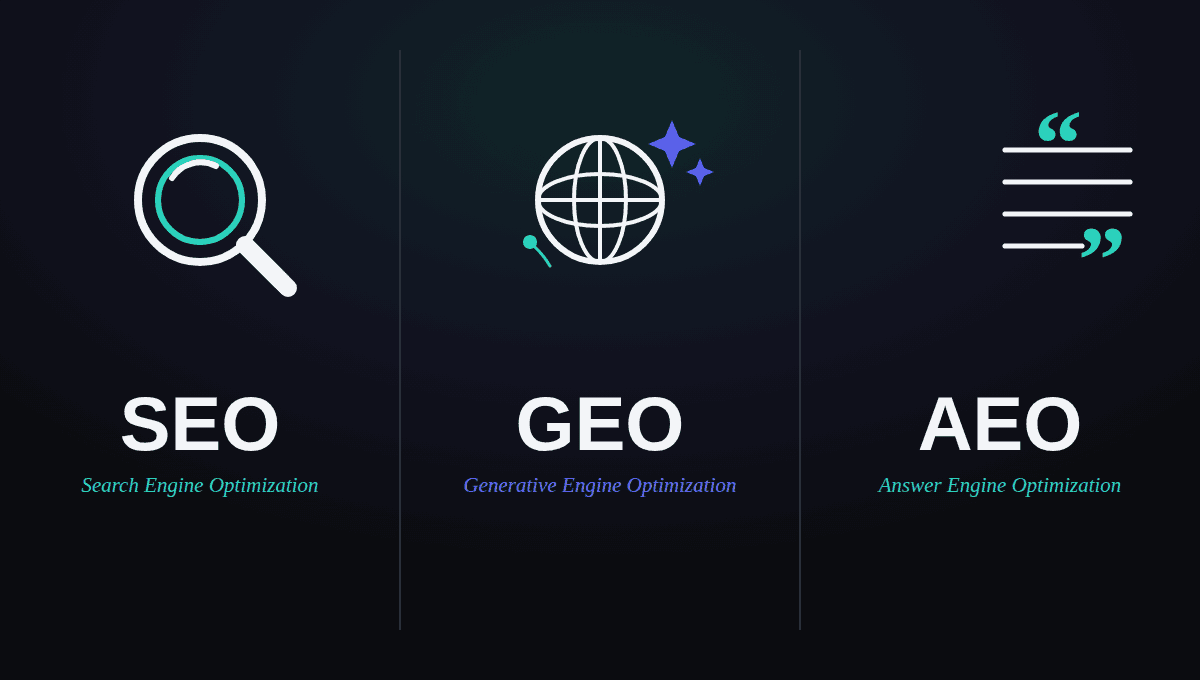
For fifteen years, get found on Google meant one thing: rank in the ten blue links. That's no longer the full picture, and treating SEO, GEO, and AEO as the same discipline with three different acronyms is how B2B and B2C teams waste a year optimizing for the wrong surface.
Three different systems, three different jobs
SEO, Search Engine Optimization, still means what it always did. You rank your pages in classic search results, mostly Google, through relevance signals, backlinks, technical crawlability, and content depth. It optimizes for a click.
AEO, Answer Engine Optimization, is about winning the direct answer: featured snippets, People Also Ask boxes, voice assistant responses, the short factual answer a search engine surfaces above or instead of a list of links. It optimizes for being the answer, not the destination.
GEO, Generative Engine Optimization, is the newest of the three. It's about being cited, quoted, or synthesized inside an AI-generated response, whether that's a Google AI Overview, ChatGPT, Perplexity, or Claude answering a question with sources woven into a paragraph. It optimizes for being the source a model trusts enough to reference. Not for a click at all.
Three different jobs, three different success metrics. Confusing them is where most of the wasted effort comes from.
The overlap that causes the confusion
All three still reward the same foundation: clear structure, genuine expertise, fast pages, and content that answers a real question instead of padding for keyword density. That overlap is why people lump them together. The tactics diverge hard the moment you move past the foundation.
Classic SEO rewards depth and internal linking that keeps a visitor on your site. AEO rewards extractable, structured, self-contained answers, the kind you can lift out of a page and still make sense. Classic SEO also rewards a clean multilingual estate once you run more than one language. GEO rewards being citable: named sources, direct quotes, data a model can attribute to you by name. A generative engine isn't sending traffic to your page. It's compressing your page into someone else's answer.
What actually changes in the work
For SEO, the work is still keyword research, backlinks, technical health, and topical authority built over months.
For AEO, I write direct, self-contained answers near the top of the page. The first sentence should answer the question the H2 poses, not tease it. I use FAQ schema markup, and I structure content so a snippet can lift a clean paragraph without needing the rest of the page for context.
For GEO, the work shifts again. I make sure a name, ours, a client's, a brand, is explicitly attached to the claim, not just implied. I write the kind of specific, dated, sourced statement a model can quote with attribution instead of vague marketing language it has no reason to cite. And I test it directly. I ask ChatGPT, Perplexity, and Google's AI Overview the actual question a buyer would ask, and see who gets cited. If it's never us, that's the gap to close.
How I decide where to spend the effort
I don't treat these as three separate budgets or three separate teams. I treat them as three lenses on the same content, and I prioritize based on where the buyer actually is in the funnel.
If the query is early and exploratory, something like what is X, GEO and AEO matter more. That's exactly the kind of question a buyer now asks an AI assistant before ever opening a search engine.
If the query is transactional or comparison-based, X vs Y, best X for Z, classic SEO still wins. Buyers at that stage still click through to compare, read reviews, and build a shortlist.
The mistake I see most B2B teams make is treating this as an either-or decision, when it's really a sequencing decision. Early-funnel content earns the GEO and AEO citation. Late-funnel content earns the click and the SEO ranking. Same content strategy, different jobs depending on where in the funnel it sits.
"If a model can't cite you by name, you don't exist in the answer it gives your buyer."
Fellipe Araujo
The channels are fragmenting, not consolidating. A buyer today might ask ChatGPT a question, get a synthesized answer with three sources, click through to compare two of them on Google, and land on a page that needs to load fast and answer their next question in the first sentence. Optimizing for only one of those moments and still calling it SEO is how good marketing teams go quiet exactly when it matters most.