The physical AI data engine has three layers, and most teams only build one
Physical AI's bottleneck stopped being the robot and became the data that trains and proves it. Here is the three-layer data engine now forming around it, World, Behavior, and Evaluation, and why the layer everyone skips is the one that actually gates scale.
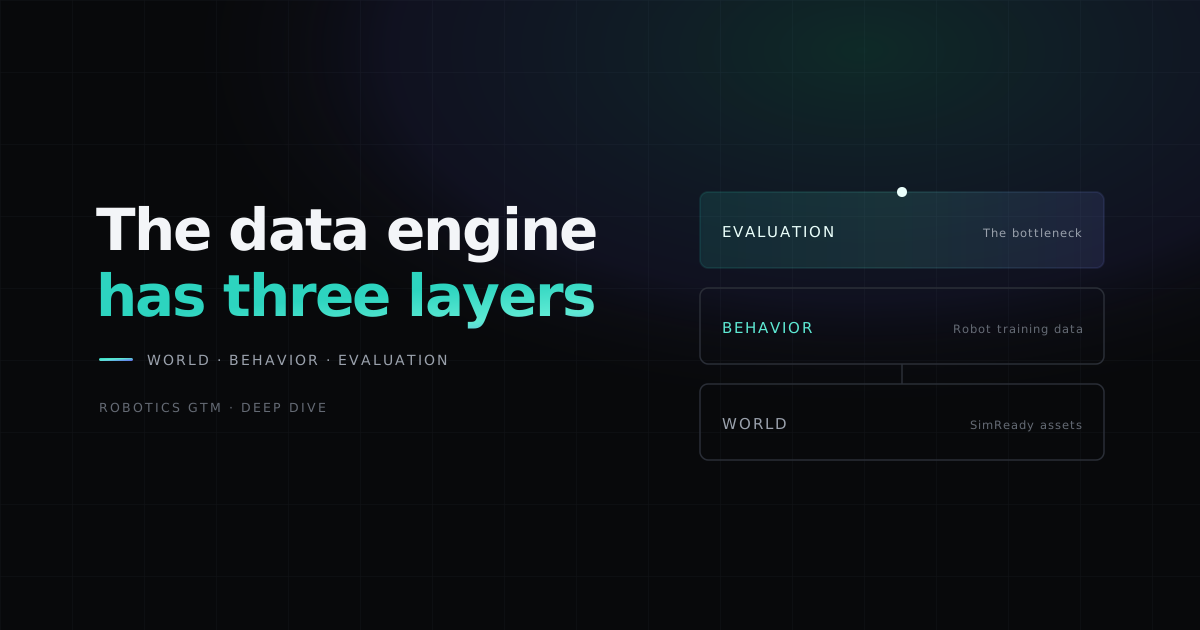
For two years the physical AI conversation was about the model: can a vision-language-action policy generalize to a task it has never seen. That question is largely answered. The one replacing it is less exciting and far more consequential: where does the data come from to train and prove that policy at scale, and who owns the pipeline that produces it. NVIDIA calls that pipeline a data engine, and it breaks cleanly into three layers, a World layer, a Behavior layer, and an Evaluation layer, each with its own bottleneck and, if you sell into this market, its own buyer.
The bottleneck moved from the robot to the data
Real-world data used to be the moat. It does not scale: the real world is messy, collecting it is slow and expensive, and the pipelines that process, simulate and evaluate it are fragmented across a dozen tools that do not talk to each other. That is exactly the gap NVIDIA's Physical AI Data Factory Blueprint, announced at GTC 2026, is built to close, an open reference architecture, built on the Cosmos world foundation models and the OSMO operator, that unifies curation, augmentation and evaluation into one pipeline instead of three separate projects. The company backed the same point with data: an open Physical AI Dataset offering 15 terabytes across more than 320,000 robotics trajectories, plus up to 1,000 SimReady OpenUSD assets, released specifically so teams do not have to build the first layer of the stack from zero.
The World layer: SimReady assets are the foundation
Everything downstream is only as good as the world the robot is trained in. SimReady is the open specification, built on OpenUSD and governed by the Alliance for OpenUSD, that defines what a 3D asset needs to carry to be trustworthy in simulation: correct mass, friction and inertia, collision geometry, material and semantic labels, validated once and reusable across every simulator that speaks the standard. Before this existed, every studio rebuilt physics-accurate assets for its own pipeline, which is the kind of invisible tax that never shows up on a roadmap slide but quietly caps how fast anyone can move. A world that is not physically accurate does not just look wrong. It teaches the robot the wrong thing, confidently.
The Behavior layer: turning worlds into training data
Once the world is physically accurate, world foundation models like Cosmos turn it into training data, generating the trajectories, camera views and edge cases a policy needs, robot-agnostic, so the same underlying behavior data can post-train a different arm, gripper or embodiment without recollecting from scratch. NVIDIA's own R2D2 research line demonstrates the shape of it: use a world model to multiply a small amount of real demonstration data into a large, diverse training set instead of paying for months of teleoperation to cover every variation a robot might meet on a real floor. This is the layer that made pretraining data genuinely abundant for the first time, and it is also where a false sense of security creeps in.
The Evaluation layer: the bottleneck now that pretraining data scales
Generating another million synthetic trajectories is now closer to a compute problem than a data problem. Trusting that a policy trained on them survives a real robot, on a real floor, on a customer's night shift, is not, and that gap is precisely why evaluation is the layer NVIDIA folded into the data factory pipeline rather than left as an afterthought. Robot-agnostic pretraining data scales exactly as fast as compute allows; the evidence that it transfers safely does not scale at the same rate, which means evaluation is quietly becoming the most expensive, most differentiating layer in the stack, the one that decides whether abundant synthetic data turns into a fielded robot or into a very convincing simulation.
- World
- SimReady, physics-accurate OpenUSD assets, the foundation everything else trains on
- Behavior
- World models generate robot-agnostic trajectories and edge cases at scale
- Evaluation
- Proves the policy transfers safely, now the layer that actually gates how fast you can scale
- What is abundant
- Synthetic pretraining data, once the world layer is solid
- What is scarce
- Trustworthy proof that a trained policy holds up outside simulation
- Who owns it
- Whoever assembles all three layers into one pipeline, not three separate vendors
Why this matters if you sell into this market, not just build in it
This is not only an engineering story. Buyers evaluating a physical-AI vendor are starting to ask about the data engine behind the robot the same way they already ask about the safety file and the deployment record, whose SimReady assets was this trained on, what does the evaluation harness actually test, does the behavior data generalize to my environment or just to the demo floor. That is the exact same proof burden I have written about before: the robot generalizes faster than the go-to-market does, and a vendor who can answer the data-engine question with specifics, not a slide, is the one who shortens the pilot instead of restarting it for every new buyer.
"Synthetic data made behavior cheap. It made evaluation the only thing left worth paying for."
Fellipe Araujo
None of the three layers is optional, and skipping straight to behavior generation because it is the most visible one is how a team ends up with an impressive training pipeline and no credible answer when a buyer asks how they know it works. The category is still being defined. The vendors, and the marketing and sales teams, who name their own data engine in these three layers now, World, Behavior, Evaluation, are the ones who will not be re-explaining their architecture from scratch to every buying committee for the next two years.
Sources and references: NVIDIA's Physical AI Data Factory Blueprint and Open Physical AI Dataset, announced at GTC 2026; NVIDIA Cosmos world foundation models; the SimReady specification governed by the Alliance for OpenUSD (AOUSD); and NVIDIA's R2D2 research on training generalist robots with world foundation models.