A consultant or a full-time hire? The case for buying outcomes, not headcount
A full-time hire is a permanent bet on a permanent problem. A lot of the work you are hiring for is neither. Here is when a consultant gets you there faster, cheaper, and with less risk, and the one case where a full-timer still wins.
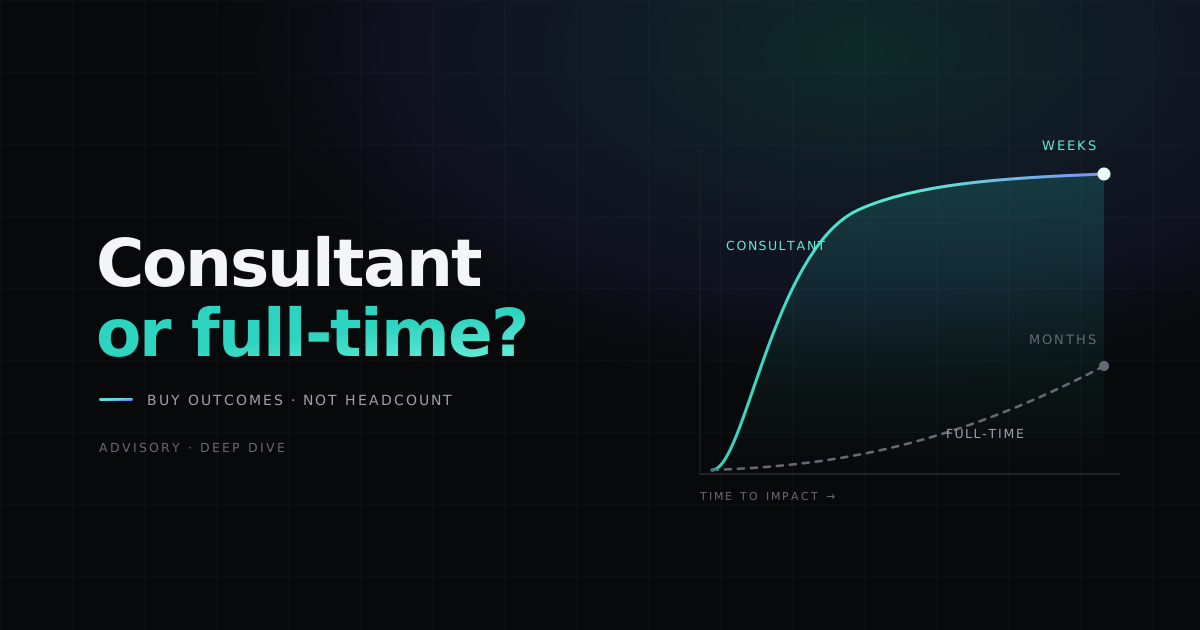
When a gap opens up, pipeline is flat, the launch is slipping, nobody owns growth, the default move is to open a role and start interviewing. It feels responsible. But hiring full-time is one of the most expensive, slowest, and hardest-to-reverse decisions a company makes, and for a large share of the work it is simply the wrong tool. The real question is not consultant or employee. It is whether you are solving a permanent problem or delivering a defined outcome.
What a full-time hire actually costs
The salary is the part everyone sees. The rest is quieter and larger. There is the recruiting cycle, weeks or months to source, interview, and close. There is the ramp, a senior hire typically needs three to six months before they are fully productive in your context. There is the loaded cost on top of base: benefits, taxes, tooling, and management time, which the common rule of thumb puts at roughly 1.25 to 1.4 times the salary. And there is the tail risk: if it turns out to be the wrong hire, you carry the cost of the miss plus the cost of unwinding it.
Six advantages a consultant brings
- 01Impact in weeks, not quarters
A consultant starts on the problem, not on onboarding. You buy momentum immediately instead of waiting two quarters to see whether the hire works out.
- 02Senior expertise, only when you need it
You get someone who has solved this exact problem many times, without paying a senior salary all year for a problem that lasts a quarter.
- 03No ramp, no overhead
No recruiting cycle, no benefits, no management load, no severance risk. The engagement ends cleanly when the outcome is delivered.
- 04Flexible and reversible
Scale up for a launch, scale down after. A full-time hire is a permanent bet; a consultant is a decision you can revisit every quarter.
- 05An outside perspective
No internal politics, no loyalty to last year's plan. A consultant can name what the org has stopped being able to see.
- 06You pay for outcomes, not seats
The engagement is scoped to a result. A salary is scoped to attendance. One of those is far easier to hold accountable.
Notice the through-line: every one of these is strongest when the work has a shape, a launch to land, a function to stand up, a system to build and hand off. That is exactly where a company least wants to spend six months hiring and hoping.
- Time to impact
- Weeks, no multi-month ramp
- Cost
- A scoped fee, not a loaded salary for the year
- Expertise
- Senior and specialized, on demand
- Commitment
- Flexible and reversible
- Perspective
- Outside-in, free of internal politics
- You are buying
- An outcome, not a seat
When a full-time hire is the right call
This is not an argument that consulting always wins. It does not. If the problem is permanent and central, a function that has to be owned every day, forever, hire for it. If the work depends on deep institutional context that only accrues over years inside your walls, hire for it. If you need someone in every room, every day, indefinitely, hire for it. A good consultant will tell you this plainly, and often the most valuable thing they do is define the role, prove out the system, and hand it to the full-timer you then hire with confidence.
"A full-time hire is a permanent answer. Make sure the problem is permanent before you pay for one."
Fellipe Araujo
How I work: advisory, fractional, or build
In practice I plug in three ways, each designed to get you senior outcomes without adding permanent headcount. Advisory: I work alongside your team on strategy and the hard calls, so you move faster without another full-time salary. Fractional: I own a slice of the function part-time, demand generation, growth, the AI-agentic layer, for as long as it needs an owner and not a day longer. Build: I build the system end to end and hand it over, so what remains is an asset your team runs, not a dependency on me. Each one is a way to buy the outcome now and decide on the headcount later, from a position of knowledge instead of guesswork.
So before you open that role, ask the honest question. If the problem is permanent and core, hire for it. If it is a defined outcome with a finish line, a consultant will almost always get you there faster, cheaper, and with far less risk, and leave you better equipped to make the permanent decisions when they come.